

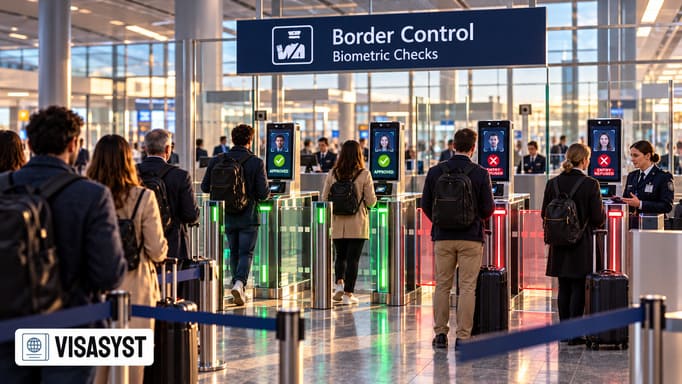
Europe's new biometric border system is operational, but its rollout has exposed significant challenges at major travel gateways. Meanwhile, uncertainty over the launch of the European Travel Information and Authorisation System (ETIAS) continues, with EU agencies reviewing implementation plans through 2027.
New analysis by VisaSyst, supported by exclusive interviews with legal and aviation experts, reveals how operational difficulties, inconsistent border procedures and uncertainty about future travel requirements are affecting international travelers.
Table of Contents
▼
Table of Contents
▼TL;DR: What Travelers Need to Know
- EES is already operational. The EU Entry/Exit System completed its six-month progressive rollout on April 10, 2026. However, several countries have reportedly requested additional flexibility in implementation amid technical and staffing difficulties.
- ETIAS has not launched. No applications are currently being accepted, and the EU has not announced a definitive launch date. Recent planning discussions have raised questions about whether operations could begin in 2027.
- Border refusals are being recorded digitally. Official eu-LISA data reports 19,985 entry refusals in the first quarter of 2026, though the figures cover only border crossings using EES during its gradual rollout.
- Traveler interest in ETIAS is growing. Exclusive VisaSyst data shows that 67.1% of ETIAS alert registrations in its 13-month study period occurred between July and September 2026.
- Experts warn of practical risks. In interviews with VisaSyst, representatives from ACI EUROPE and immigration law firm Fragomen highlighted border-processing delays, incomplete travel records and the importance of independent compliance checks.
What Is the Current Status of EES and ETIAS?
Although they are part of Europe's wider border digitalization strategy, EES and ETIAS are separate systems with different purposes and implementation schedules.
The EES records passport information, facial images, fingerprints where required, and entry and exit dates. It is intended to replace manual passport stamping for travelers within its scope and help authorities identify overstays.
ETIAS, by contrast, will require eligible visa-exempt travelers to obtain authorization before visiting the 30 participating European countries.
EES delays do not mean ETIAS is already required, and ETIAS delays do not suspend existing Schengen entry rules.
Why Are Some European Countries Still Experiencing EES Delays?
The EES officially completed its progressive implementation on April 10, 2026. However, reaching that regulatory milestone has not eliminated operational difficulties.
In September 2026, media reports indicated that nine European countries, including France, Germany, Greece and Italy, were seeking additional flexibility in applying EES requirements.
The reported concerns included inadequate infrastructure, technical limitations and difficulties managing biometric registration at busy border crossings.
These developments have raised an important question: Can countries legally suspend EES implementation once the system is fully operational?
Does EU law allow countries to suspend EES?
Legal expert Thomas Wahl, Research Group Leader at the Max Planck Institute for the Study of Crime, Security and Law, cautions against claims of a general EES suspension mechanism.
In a written interview with VisaSyst, Wahl explained:
“I cannot find a 'flexibility clause' or a clause of explicit 'temporary suspension' in the underlying EES Regulation 2017/2226.”
He instead pointed to Article 21 of the regulation, which sets out fallback procedures when authorities cannot enter information into the central system or when relevant infrastructure fails.
Under those circumstances, countries must temporarily store the necessary information and enter it into the system when normal operations resume.
Wahl emphasized that his interpretation depends on the circumstances of the reported national requests and the European Commission's response.
Why this distinction should matter to international travelers: reported operational flexibility should not be interpreted as a general exemption from EES registration.
Even where technical or logistical constraints disrupt biometric processing, applicable immigration and border-control requirements remain in force.
Which countries are affected by EES implementation problems?
The September reports identified nine countries requesting additional flexibility, including several major European destinations.
However, the situation should not be confused with an officially authorized suspension of EES across those countries.
There is also no reliable basis for assuming that every airport within a particular country has identical processing conditions.
Travelers should check their airline, airport and national border authority for current operational information before departure.
Are EES Border Checks Causing Longer Airport Queues?
Airport operators say that when assessing EES delays, they must consider biometric technology, system reliability and the availability of border-control officers.
In an exclusive interview with VisaSyst, an ACI EUROPE spokesperson identified several interconnected challenges:
- Structural shortages of border-control personnel.
- Disruptions and connectivity problems affecting central and national IT systems.
- Technical limitations involving self-service kiosks and automated border gates.
Limited deployment and functionality of the Travel to Europe mobile application.
These problems can reinforce one another.
Even when automated equipment is available, travelers may still require assistance or intervention from border-control personnel.
The ACI EUROPE spokesperson told VisaSyst:
“Border-control staffing shortages and technical limitations both constrain EES processing capacity.”
Why are connecting flights particularly vulnerable?
Lengthier passport-control procedures can affect passengers connecting between international and Schengen-area flights.
At major European hubs, a traveler arriving from outside the Schengen Area may need to pass immigration before reaching a connecting flight.
ACI EUROPE confirmed to VisaSyst that airline industry representatives have reported passengers missing connections because of excessive border waiting times.
The organization also highlighted an important operational distinction: border control is a national government responsibility, not an airport operator responsibility.
Airports can support queue management, passenger information and crowd organization. However, they cannot independently deploy additional border guards or eliminate systemic IT problems.
For travelers, the practical implication is straightforward: allow sufficient time for immigration procedures, especially when booking separate tickets or self-transfers.
A connection that previously seemed comfortable may carry additional risk when border-processing conditions are unpredictable.
Nearly 20,000 Entry Refusals Recorded in Early 2026
EES is changing more than how passengers move through airports. It is also creating a digital record of entry decisions and short-stay travel histories.
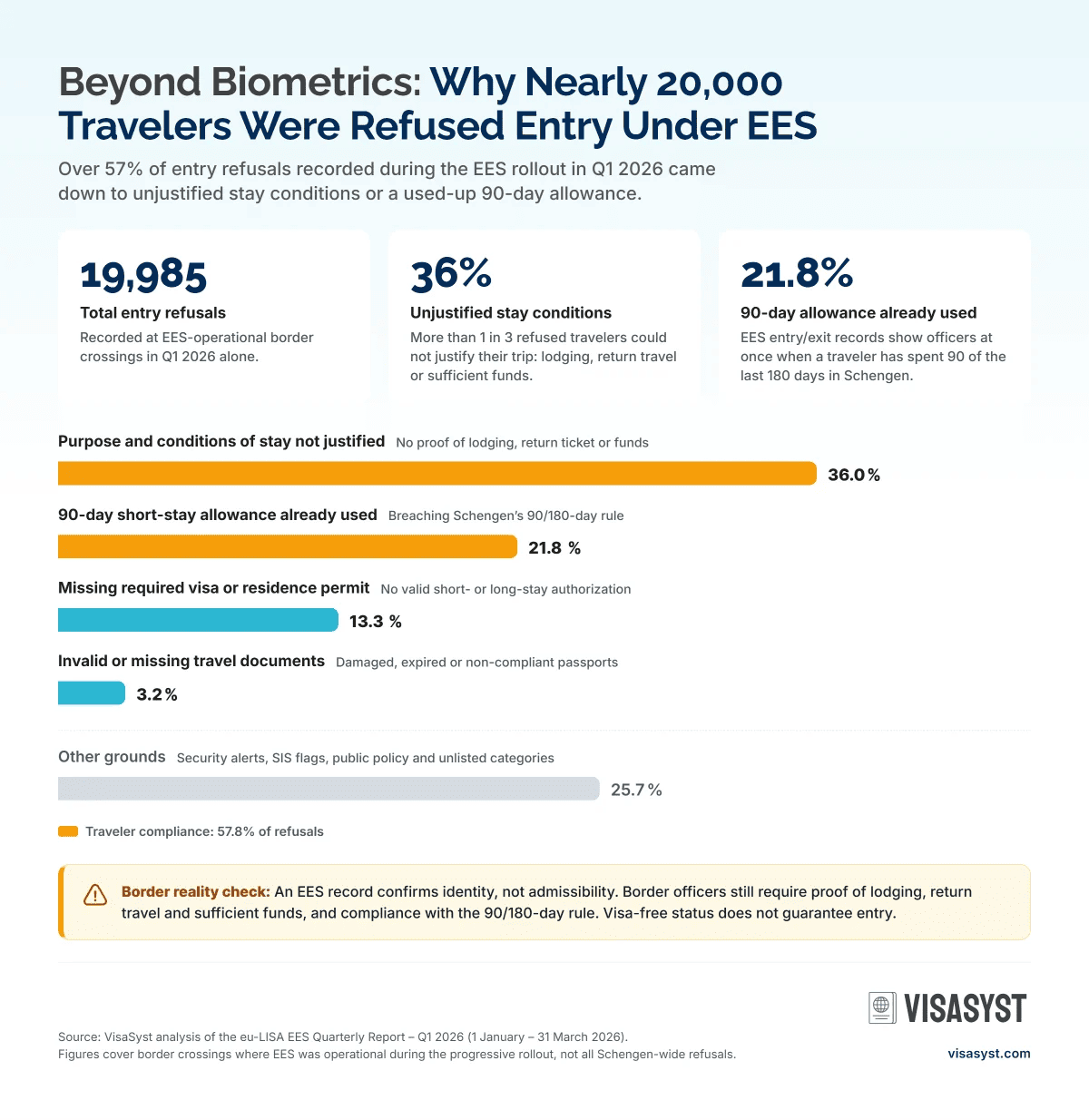
According to the eu-LISA EES Quarterly Report for Q1 2026, the system recorded 19,985 entry refusals between January 1 and March 31, 2026.
The same report documented extensions of authorized stays, revocations and exemptions from fingerprint collection. Importantly, the system was still being introduced progressively during this reporting period.
Note: These figures represent records from EES-operational border crossings, not every entry refusal across the Schengen Area.
What were the main reasons for entry refusal?
VisaSyst's review of the official first-quarter statistics identifies several notable categories.
Source: VisaSyst calculations based on eu-LISA's EES Q1 2026 report. Categories are not exhaustive.
Taken together, these figures demonstrate why travelers need to look beyond biometric registration.
An EES record does not replace a valid passport, proof of accommodation, evidence supporting the purpose of travel, or the appropriate visa where required.
Similarly, visa-exempt status does not guarantee admission.
Border officials remain responsible for assessing whether travelers meet applicable entry conditions.
VisaSyst Data: Interest in ETIAS Surges Despite Launch Uncertainty
While official EU announcements focus on implementation milestones, VisaSyst's internal data offers another perspective: how travelers are responding to ETIAS uncertainty.
VisaSyst analyzed ETIAS alert registrations collected between September 2025 and September 2026.
The analysis shows a substantial increase in traveler interest during the summer of 2026, even though ETIAS did not accept applications.
ETIAS alert registrations concentrated in summer 2026
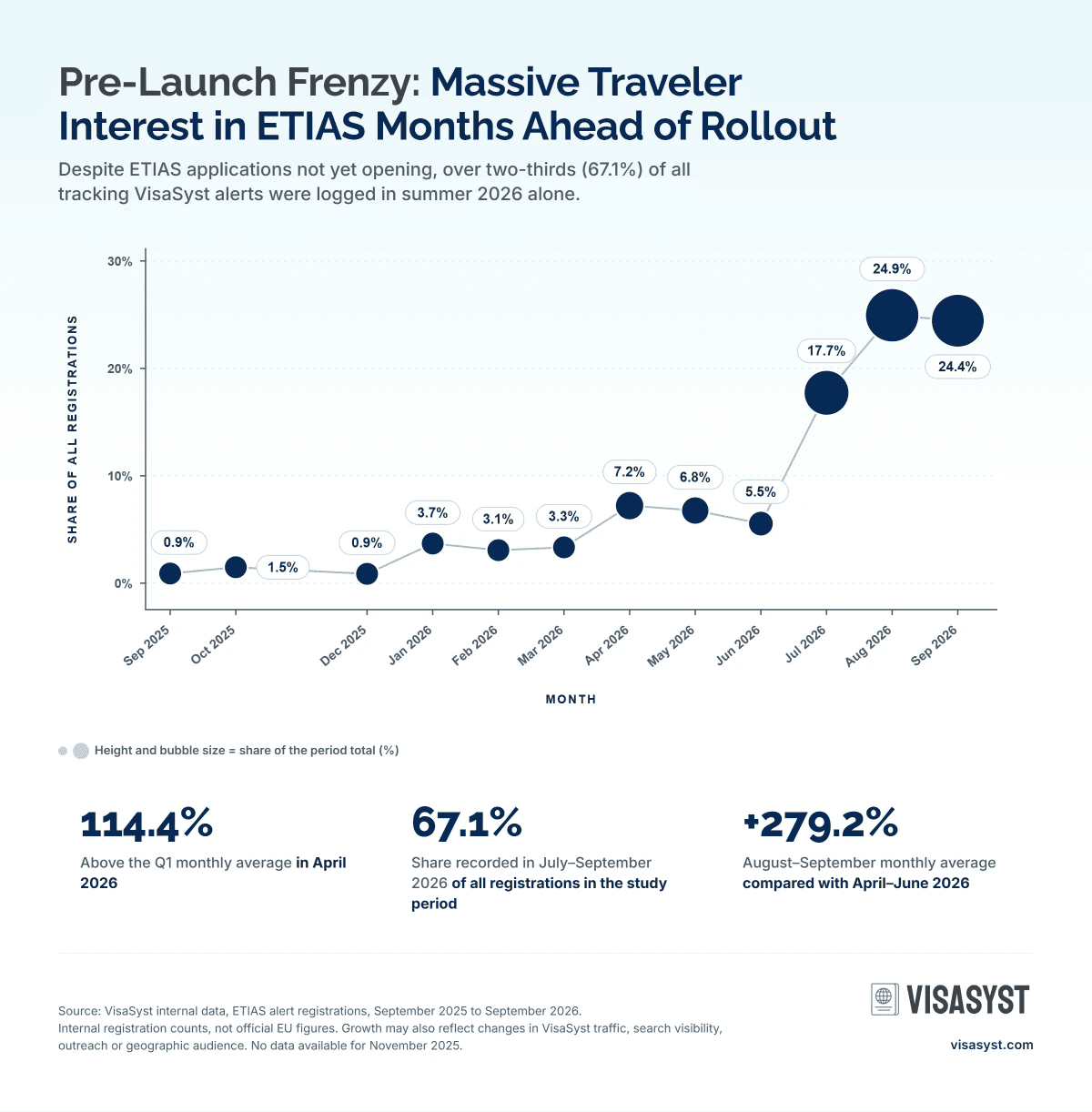
Using the average monthly registrations from January to March 2026 as a baseline of 100, April registrations reached an index of 214, representing a 114.4% increase.
Interest grew substantially again later in the year.
Between July and September 2026, registrations accounted for 67.1% of the entire study-period total.
The monthly average for August and September was also 279.2% higher than the average for April through June.
These changes suggest that interest in receiving ETIAS information intensified considerably as travelers prepared for future trips.
However, registration growth should not be attributed exclusively to EU policy announcements. Changes in VisaSyst's traffic, search visibility, outreach or geographic audience may also have contributed.
Which nationalities are showing the most ETIAS interest?
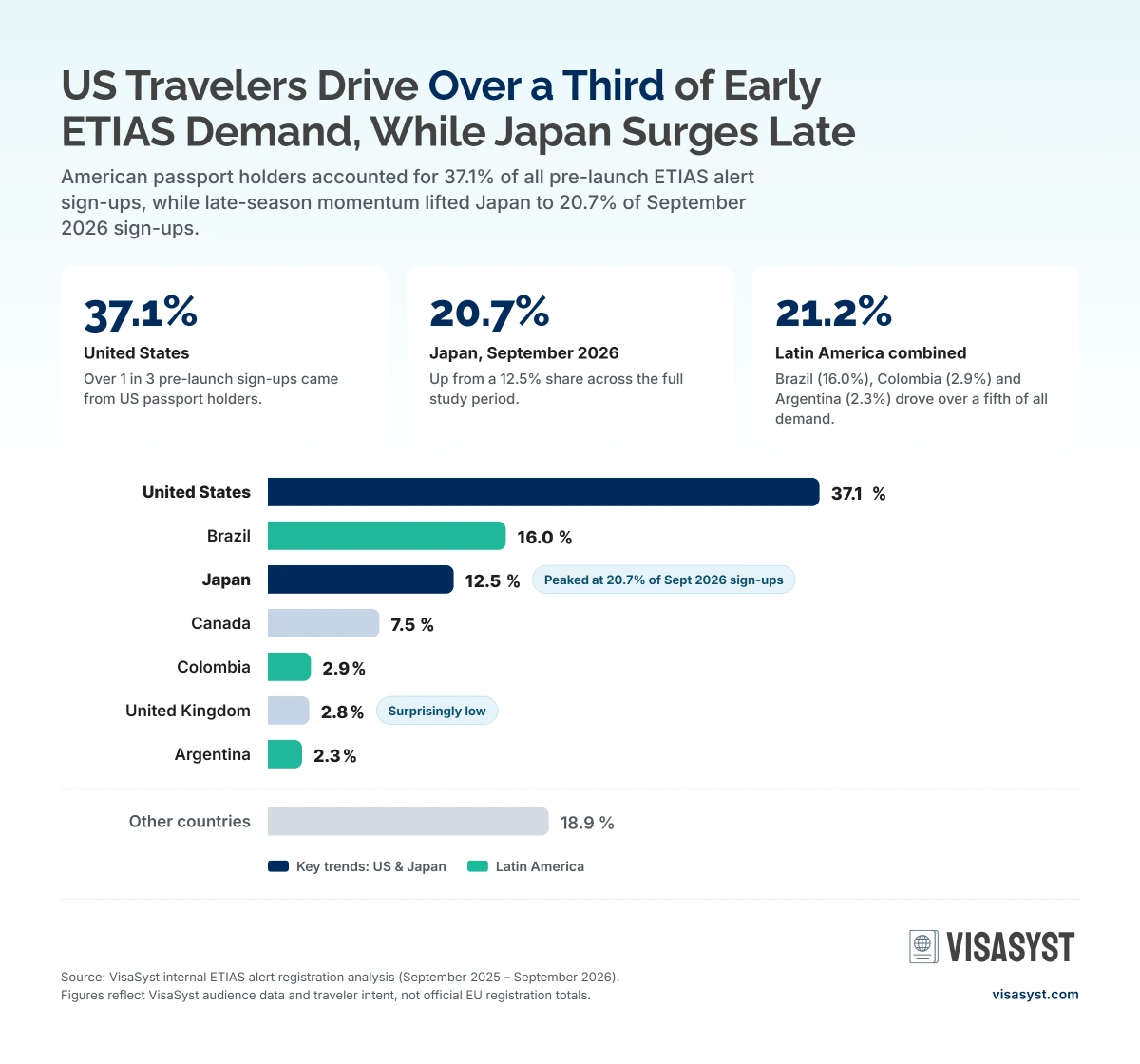
The country-of-passport breakdown shows which groups engage most with ETIAS information.
Share of VisaSyst ETIAS alert registrations by nationality, September 2025–September 2026.
The United States represented the largest segment of VisaSyst's registration sample.
Japan was another notable market. Its share of monthly registrations increased substantially during the final quarter of the study period, reaching 20.7% in September 2026.
This shift may reflect changes in audience composition as much as changes in traveler awareness.
Note: These percentages describe VisaSyst's own audience, not the national distribution of all future ETIAS applicants or international visitors to Europe.
What are travelers asking about ETIAS?
VisaSyst also reviewed incoming contact-form messages related to ETIAS.
Several recurring themes emerged across more than 400 analyzed inquiries.
1. “Is ETIAS already mandatory for travel to Europe?”
Travelers frequently asked whether authorization was required for journeys scheduled in late 2026 or early 2027.
Some had already booked flights and wanted to know whether the rules might change before departure.
2. “Where can I apply for ETIAS?”
A recurring question concerned where to apply for ETIAS.
Some users said they repeatedly tried to access online application pages but couldn't find a working application form.
Others asked whether they had already completed the necessary registration.
3. “Do I need ETIAS for my nationality?”
Some inquiries focused on whether particular nationalities qualified for ETIAS.
Others appeared to confuse visa eligibility, visa exemptions and future ETIAS authorization requirements.
4. “Will ETIAS affect my upcoming trip or connecting flight?”
Travelers asked whether upcoming journeys, including flights connecting through Schengen airports, would be affected by a possible ETIAS launch.
These inquiries highlight something that coverage of European border policy can easily miss: travelers need more than an estimated launch date. They need to understand which requirements actually apply on their departure date.
Methodology: VisaSyst analyzed unique ETIAS alert registrations from September 2025 through September 2026. We excluded duplicate registrations and records outside the defined period. Nationality reflects the passport country entered during registration. The contact-form findings are qualitative observations from anonymized messages, not a representative traveler survey. Registration data measures interest in information alerts, not completed ETIAS applications.
ETIAS Is Not Operational & the EU Has Not Announced A Final Launch Date
The European Commission's official ETIAS website still states that travelers cannot submit applications and that the EU will announce the start date several months in advance.
However, recent developments have introduced uncertainty about the timeline.
On September 24, 2026, eu-LISA reported that its Management Board had reviewed implementation planning for EES and ETIAS.
The Board also discussed scenarios for revising the wider interoperability roadmap for 2027–2028 and asked the agency to clarify the necessary preconditions before its next meeting.
The announcement did not formally establish a new ETIAS launch date.
Nevertheless, it indicates that implementation planning remains under review, making a 2027 launch an important scenario to monitor.
What must happen before ETIAS can launch?
Thomas Wahl also addressed this question in his interview with VisaSyst.
He referred to Article 88 of Regulation (EU) 2018/1240, which establishes the legal framework for bringing ETIAS into operation.
As Wahl explained:
“The European Commission determines the date from which the system is to start operations once certain conditions are fulfilled.”
This distinction helps clarify the difference between technical planning discussions and an official launch announcement.
Operational readiness of the necessary systems is essential, but discussing a revised timetable does not itself create a legally confirmed start date.
For travelers, the most reliable reference remains an announcement from the European Commission through its official ETIAS channels.
Until applications open, travelers do not need to obtain ETIAS authorization.
What Key EES and ETIAS Stakeholders Told VisaSyst
VisaSyst sought perspectives from specialists in EU law, airport operations and corporate immigration to better understand the implications of the EES rollout and uncertainty around ETIAS.
Their responses point to three distinct challenges: legal interpretation, operational capacity and reliable travel records.
Thomas Wahl: EES Flexibility Needs a Clear Legal Basis
Research Group Leader, Max Planck Institute for the Study of Crime, Security and Law
"I cannot find a 'flexibility clause' or a clause of explicit 'temporary suspension' in the underlying EES Regulation 2017/2226."

Wahl's analysis suggests that reports of countries suspending EES should be examined against the regulation's actual provisions.
ACI EUROPE: Technology Alone Cannot Solve Border Delays
European airport industry association
"Sufficient national border-control personnel, reliable IT systems and effective automation are all essential to ensuring that EES operates efficiently."

The association's assessment emphasizes that improving passenger processing requires coordinated action by governments, airport operators and airlines.
Jo Antoons: Incomplete EES Records Can Create Compliance Risks
Attorney and Senior Counsel, Fragomen
“The risk [of the EES uneven enforcement] extends beyond inconsistent biometric collection to inaccurate or incomplete EES records. Potential problems include multiple records for the same traveler and exit dates not being recorded, which can create a false indication of overstay.”

In her responses to VisaSyst, Antoons recommended that companies managing international business travel keep independent records of employees' trips, including proof of departure, to help challenge incorrect overstay records.
She also advised companies to identify travelers who will require ETIAS and incorporate authorization checks into business travel approval procedures.
Her central message is that preparation should extend beyond ETIAS alone.
Employers must also consider the legal basis for entry, employment-related permissions and other obligations relevant to international business travel.
How Should Travelers Prepare for EES and ETIAS?
The uncertainty surrounding ETIAS does not prevent travelers from taking practical steps now.
Before traveling to Europe
- Check your passport and visa requirements. Confirm whether you qualify for visa-free travel or need a Schengen visa.
- Calculate your permitted stay. Most short-stay travelers are subject to the 90-days-in-any-180-day-period rule. EES does not increase this allowance.
- Allow additional connection time. Border-control procedures may take longer than expected at busy international gateways.
- Keep evidence of previous trips. Boarding passes, tickets, and other travel records may help resolve discrepancies involving entry or exit dates.
- Follow official ETIAS announcements. Do not assume an authorization is necessary until the system has launched and the applicable requirements are in force.
Travelers can also consult the EU's official EES stay-checking tool.
Its results must be interpreted carefully. The EU warns that its remaining-stay calculation does not reflect Schengen stays that began before April 10, 2026.
What if your EES travel record is incorrect?
Travelers subject to EES have the right to access their personal information and request corrections to inaccurate or incomplete records.
These requests should be directed to the relevant national authority responsible for processing EES data.
As Jo Antoons noted in her interview with VisaSyst, practical difficulties in obtaining timely corrections can create additional challenges for travelers.
Maintaining supporting documentation may therefore be particularly valuable for frequent visitors and business travelers.
Further information is available through the EU's official EES data protection guidance.
Staying Informed About Europe's Changing Entry Requirements
The EES implementation experience shows that bringing a new European border system into operation involves more than announcing a start date.
Technical readiness, national implementation and traveler understanding all affect how new requirements work in practice.
ETIAS will introduce another important step for visa-exempt travelers, but its eventual launch will not replace passports, existing immigration rules or other relevant travel permissions.
VisaSyst will continue to review official EU announcements and monitor developments affecting international travel documentation.
As an independent travel document assistance service, VisaSyst helps travelers understand requirements and navigate application processes for a service fee. It is not affiliated with the European Union or any government authority.
Sources and Research Methodology
Official European Union sources
- eu-LISA: EES Quarterly Report, Q1 2026
- eu-LISA: Management Board announcement, September 24, 2026
- European Union: Official EES information
- European Union: Official ETIAS information
- European Union: EES personal data and traveler rights
- Regulation (EU) 2017/2226 establishing the EES
- Regulation (EU) 2018/1240 establishing ETIAS
Exclusive interviews conducted by VisaSyst
- Thomas Wahl, Max Planck Institute for the Study of Crime, Security and Law. Written responses concerning EES legal provisions and the legal requirements for launching ETIAS.
- ACI EUROPE spokesperson. Written responses concerning airport operational capacity, border delays and connecting passengers.
- Jo Antoons, Fragomen. Written responses concerning EES data accuracy and corporate travel compliance.
Original VisaSyst research
- VisaSyst ETIAS alert registration dataset, September 2025–September 2026. Analysis of deduplicated records with identified anomalous traffic excluded.
- Anonymized ETIAS contact-form inquiries reviewed for recurring traveler questions and concerns.
Editorial note: Information is accurate to the sources reviewed on October 23, 2026. EU implementation schedules and operational guidance may change. Travelers should verify applicable requirements before departure.